


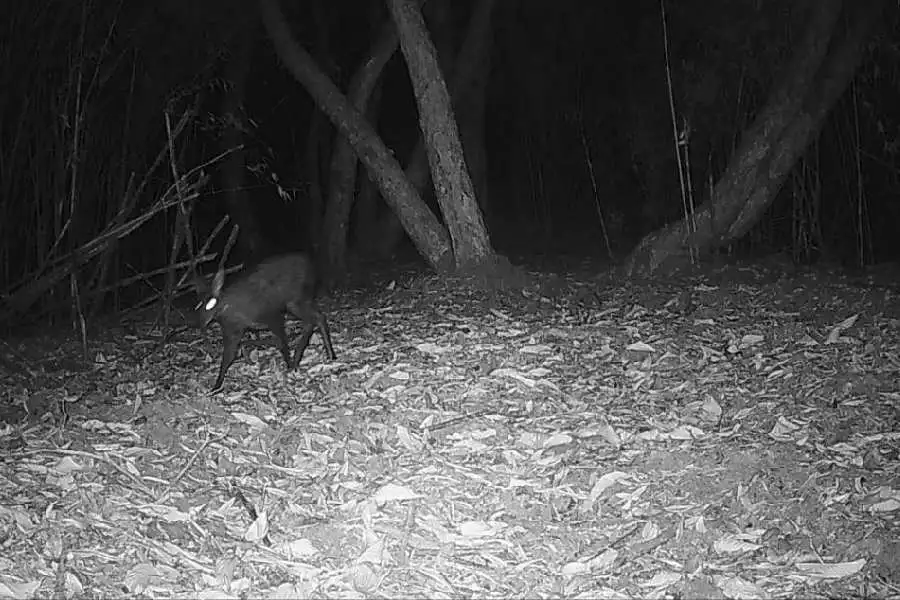
Kalimpong, November 30 (Siliguri Chronicle) – The elusive Himalayan musk deer, listed as an endangered species on the IUCN Red List, has been spotted in Bengal for the first time in nearly 70 years. The animal was photographed inside Neora Valley National Park in Kalimpong district.
The images were taken on December 17, 2024, by a trap camera set up by the Wildlife Institute of India (WII), confirming the species’ presence in the state for the first time since 1955.
The cameras, which were originally installed to study red pandas, captured several clear images of the musk deer from different angles. But the state forest department was not informed about the discovery until recently. The camera data had been sent directly to the Wildlife Institute of India (WII) in Dehradun, keeping Bengal’s forest officials unaware of the sighting.
Bhaskar JV, chief conservator of forests (wildlife, north), said the WII has yet to share detailed information about the findings with the department.
“It is disappointing that the WII has not provided the details to us, even though we are the apex department in the state, and the national park is also located in our state,” Bhaskar said.
According to official records, the last confirmed sighting of a musk deer in Bengal was in 1955 at Singalila National Park in Darjeeling and no photographs were taken at the time.
The newly captured images have therefore sparked significant excitement among the state’s wildlife community.
Wildlife researcher Animesh Bose, who has taken part in several surveys in the Neora Valley forest, said the discovery underscores the region’s rich yet largely unexplored biodiversity.
“We would urge the state forest department to prioritise habitat protection and conservation for the musk deer. We also hope that Unesco will consider the proposal to recognise the national park as a world heritage site,” he said.
In 1999, Neora Valley National Park was nominated for UNESCO heritage status, but the recognition is still pending. With several Red List species — including the Bengal tiger, golden cat, and now the Himalayan musk deer — the park remains one of India’s most biodiverse and least disturbed forest areas.
Bhaskar Das, a Jalpaiguri-based member of the governing council of the Indian Mountaineering Foundation, noted that while musk deer populations have been documented in Jammu & Kashmir, Arunachal Pradesh, Uttarakhand, Sikkim, and other sub-Himalayan forests, this is the first photographic evidence of the species in Bengal.
“Considering that it is an endangered species, an urgent assessment of its habitat in Neora Valley is needed. Also, entry into the park’s virgin forests for any purpose other than scientific research should be banned to strengthen the case for the Unesco recognition,” he said.
