


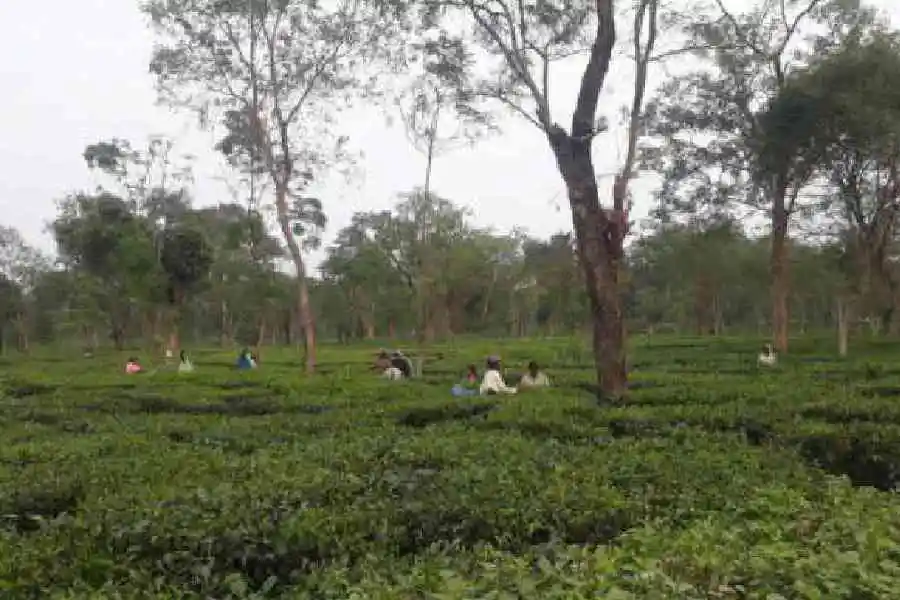
Siliguri, July 15 (Siliguri Chronicle) – Tea gardens across the plains of north Bengal saw production fall by as much as 25% in June, mainly due to poor weather and pest attacks, according to a report by the Tea Research Association (TRA).
The TRA, based in Jorhat, Assam, also operates offices in north Bengal. It is a registered society backed by the Tea Board and supported by the tea industry.
Tea production usually increases in June, one of the monsoon months.
“Tea production decreased in the Dooars during June this year by 0.4 per cent to 25.5 per cent. Yield was less on plantations in and around Jainti, Dalgaon and Kalchini (all in Alipurduar district) and Binnaguri, Damdim, Nagrakata and Chalsa (which are in Jalpaiguri district), as compared to the production in the corresponding month of 2024,” said a source in the TRA.
The overall drop in tea production in the Dooars was 10.3 per cent compared to June 2024, the source said. In the Terai, production fell by 6.52 per cent in June.
Experts at the TRA noted that the Dooars received 1,214mm of rainfall in June 2024, while this year’s total was only 505.4mm.
“Last year, the highest June temperature in the Dooars tea belt was 34.7 degrees Celsius. This time, the mercury soared to 36.9 degrees. Less rainfall and higher temperatures were to blame for the drop in the tea production,” said an expert.
In addition to adverse weather, tea gardens were affected by pest infestations, including green fly, thrips, and red spider mite. “Bacterial and fungal infections also damaged tea leaves,” an expert said.
The Terai recorded no rainfall during the first 10 days of June. High daytime temperatures and pest attacks slowed the growth of tea bushes.
“Every year, production reaches its peak during the rainy season. But this year, adverse weather affected the production in June. Similar weather conditions persist even in July. We hope the situation will improve in the coming months,” said a tea planter in Siliguri.
Along with the estates, the small tea sector—which contributes over half of north Bengal’s total tea production—also suffered losses.
“Most of the growers are in crisis because of low yield and pest attacks on the plantations. We are in touch with the experts to address the situation. There had been a similar situation in the neighbouring state of Assam,” said Bijoygopal Chakraborty, the president of the Confederation of Indian Small Tea Growers’ Associations.
