


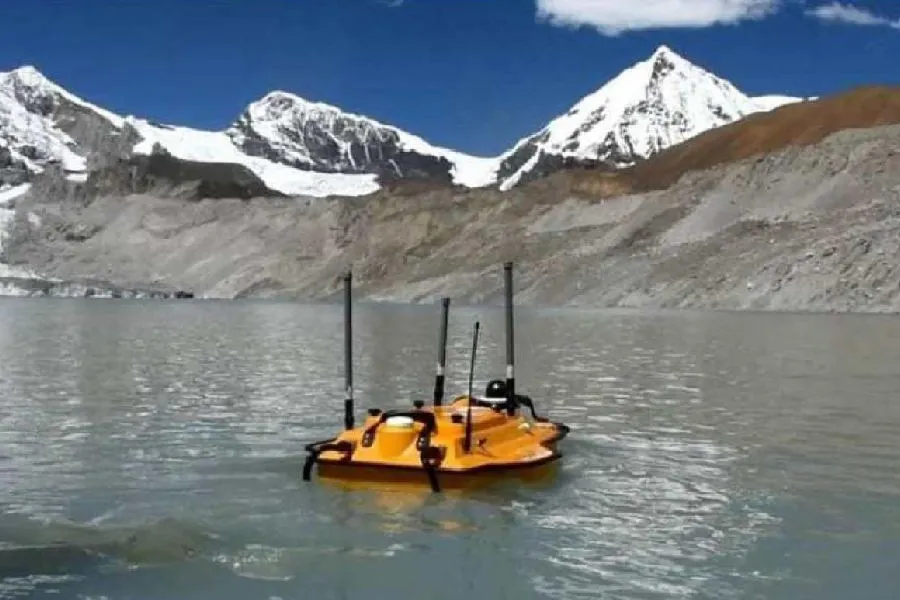
Sikkim, July 13 (Siliguri Chronicle) – In a major step to reduce the risk of glacial lake outburst floods (GLOFs), the Sikkim government has completed a detailed scientific survey of three high-risk glacial lakes in remote areas of West Sikkim.
The expedition was carried out by the state’s science and technology department in coordination with the mines and geology department. An eight-member team of experts—including glaciologists, geographers, geologists, and civil engineers—conducted the fieldwork between June 19 and July 1 as part of an ongoing hazard assessment of vulnerable glacial lakes.
The team surveyed Tiklip Lake, Bhaley Pokhri, and Doodh Pokhri—three remote glacial lakes located in Gyalzing district. Reaching these sites required a demanding four-to-five-day trek from Yuksom, the nearest motorable point, situated about 120km from Gangtok.
The mission follows the deadly glacial lake outburst flood (GLOF) from South Lhonak Lake on the night of October 3–4, 2023. That disaster claimed more than 100 lives, destroyed homes, and swept away the 1,200MW Teesta Stage III hydel power project.
In response to the South Lhonak disaster, the Sikkim government launched its first-ever statewide glacial lake survey in October–November 2024. The survey covered 320 glacial lakes across the state, identifying 16 as vulnerable to potential GLOF events.
As part of the latest expedition, the team carried out Electrical Resistivity Tomography (ERT) surveys at all three high-risk lakes to assess the stability of their surrounding terrain and underlying structures.
“These high-resolution geophysical investigations are aimed at understanding the internal structure and stability of the moraine dams holding these glacial lakes,” said a senior official.
The ERT data help identify buried ice, water-saturated zones, and possible seepage channels—key indicators that can signal the risk of a glacial lake outburst.
As part of the mission, the team also repaired hydro-meteorological sensors near the East Rathong glacier, located below Bhaley Pokhri. This work restored the sensors’ connection to the region’s Automatic Weather Station (AWS) network. These instruments will now provide continuous readings on temperature, rainfall, humidity, and wind—essential data for long-term climate monitoring in the sensitive Himalayan ecosystem.
Additionally, the team measured water discharge at Bhaley Pokhri to aid real-time hydrological assessments of the lake.
