


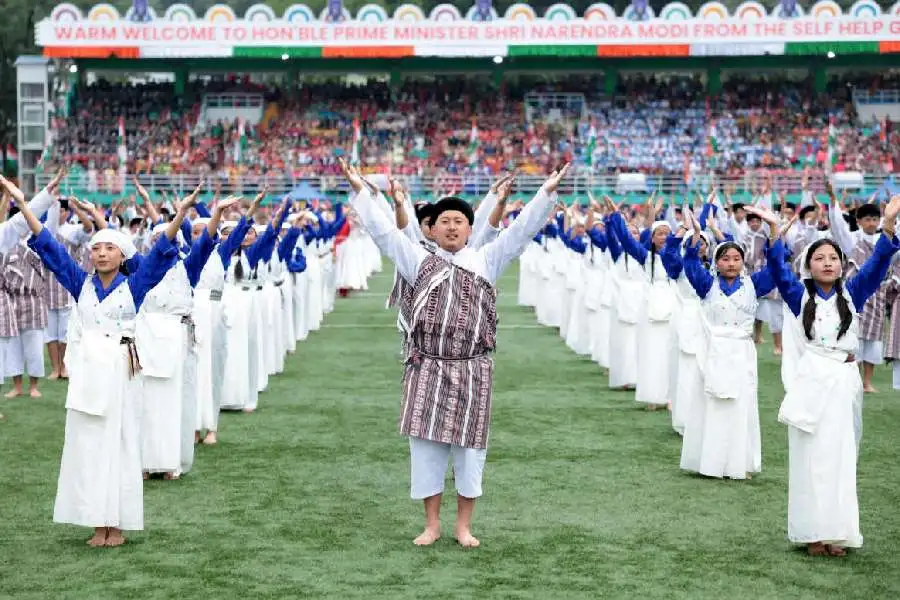
Sikkim, November 04 (Siliguri Chronicle) – Sikkim’s home department has asked all government employees to wear traditional attire to work every Thursday to celebrate the state’s rich cultural diversity and heritage.
According to a circular issued on Monday, the government will observe every Thursday as ‘Traditional Wear Work Day.’
The home department said the initiative was taken “in recognition of the rich cultural diversity and enduring traditions that define the unique identity of Sikkim,” and to encourage pride in the state’s heritage among government employees and affiliated organisations.
Sikkim is home to diverse communities — including the Nepalis, Lepchas, Bhutias and others — each with their own distinctive traditional attire.
“In this regard, it has been decided that all officers and staff members of all departments, public sector undertakings (PSUs) and banks under the government of Sikkim shall observe ‘Traditional Wear Work Day’ every Thursday, with immediate effect,” the circular reads.
The statement further states: “On this day, employees are encouraged to wear traditional attire that showcases the diverse cultural fabric of our state.”
In recent months, several departments in Sikkim had informally encouraged their staff to wear traditional attire once a week. The state government has now formalised the practice by designating every Thursday as the official day for traditional wear.
The move has drawn parallels with similar initiatives — and occasional controversies — in neighbouring regions, where traditional clothing has sometimes intersected with broader socio-political debates.
Sikkim’s new directive also mirrors Bhutan’s long-standing policy, which requires public officials and students to wear national dress — the gho for men and the kira for women — in government offices and educational institutions.
“The move in Bhutan was designed to unify the kingdom’s national identity,” the source added.
In the Darjeeling hills, clothing once became a symbol of politics and identity when Gorkha Janmukti Morcha (GJM) leader Bimal Gurung urged residents to wear traditional attire for a month. The move, in the late 2000s, was seen as a cultural assertion tied to the demand for a separate Gorkhaland state.
“Gurung’s message was positioned as a call for unity, but it sparked discontent among many as his supporters even smeared black paint on those who had refused to accept his diktat,” said a source.
A senior Sikkim government official earlier told this newspaper that the initiative was not inspired by any other state or country. “This is simply our own way of showing respect for our traditions,” the official said.
