


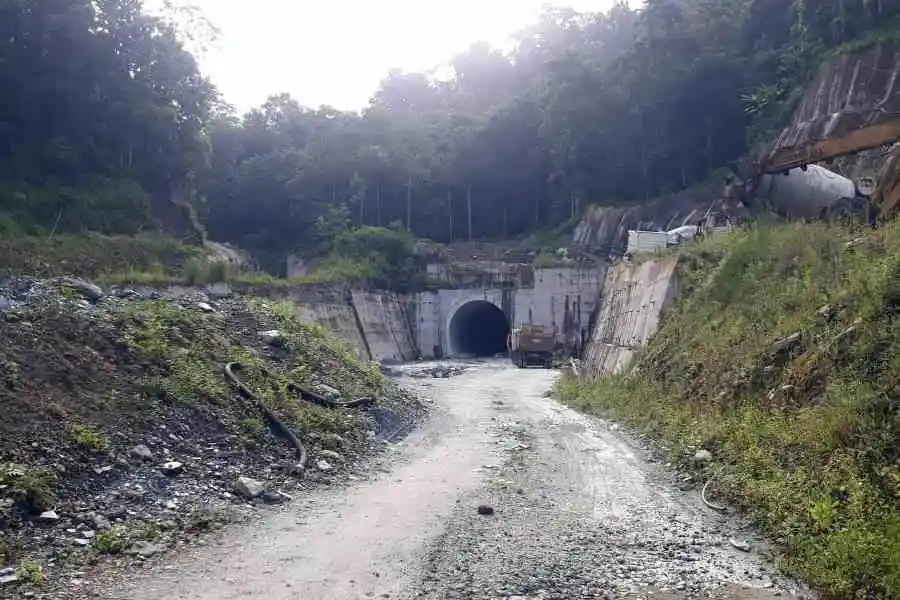
Sikkim, August 10 ( Siliguri Chronicle) – An external wall at the entrance of a tunnel on the Sikkim railway link has collapsed, sparking fresh calls for a scientific review of the ₹12,500-crore project.
The wall, part of tunnel 7 that will connect Geilkhola and Rabijhora, gave way in a landslide near Rabijhora on Tuesday morning. Scientists have long warned about unstable slopes along the route, raising concerns over the safety of the tracks.
An adit portal, a horizontal or semi-horizontal passage cut into a mountainside for construction or mining, is often used to provide access, ventilation, or drainage.
According to sources, the landslide struck about 30 metres from the tunnel. They added that both the main tunnel and the adit tunnels remain safe.
BJP’s Kurseong MLA, B.P. Sharma (Bajgain), has raised concerns with Prime Minister Narendra Modi about pushing ahead with mega infrastructure projects in the region. “Although the railway project is currently in its final phase, scientific re-evaluation is urgently required to prevent further disasters…,” Bajgain wrote in the letter dated
August 7.
The MLA pointed out that the hills here are made up of high-grade metamorphic rocks including gneiss, schist, phyllite, and slate which are known for their structural weakness and tendency to fracture.
“Additionally, sedimentary rocks like sandstone and conglomerates and some igneous rocks like dolerite dykes and basalts are also present, which are comparatively fragile,” said Bajgain.
The 45km railway line connecting Rangpo, the border town in Sikkim, with Sevoke in Bengal will include 14 tunnels.
It runs along the same hills as NH10, the lifeline linking Sikkim and Kalimpong with the rest of the country. Experts have already warned that NH10’s stability has been compromised by large hydroelectric projects in the area.
A soil expert, who has worked in the Sikkim-Darjeeling region, recently said: “From a technical soil-physics perspective, the fate of NH10 is sealed. It will never be the same as it was before the dams were built.”
The 78.58km highway linking Rangpo on the Bengal-Sikkim border to the rest of India follows the Teesta river for about 52km. Along this stretch, the 132MW Teesta Low Dam-III and the 160MW Teesta Low Dam-IV were built between 2013 and 2016 at a combined estimated cost of around ₹3,200 crore. This section is considered the most vulnerable part of the highway.
Experts said that long reservoirs created by the dams resulted in deep waters of up to 25m in the valley bottom where previously white-water rapids flowed. “The tremendous pressures of the water column help in pushing the water into the foot slopes of the hills forming the valley. This changes the character of the soil,” the expert stated.
“This had led to the entire stretch of soil layers at the base of the hillslopes and valley bottom between Kalijhora and Tribeni — the endpoints in the 25km ‘reservoir’ stretch, to be saturated with water,” the expert added.
In his letter, the Kurseong MLA also highlighted the problems caused by the dams on the Teesta.
